The Last Quest for Love
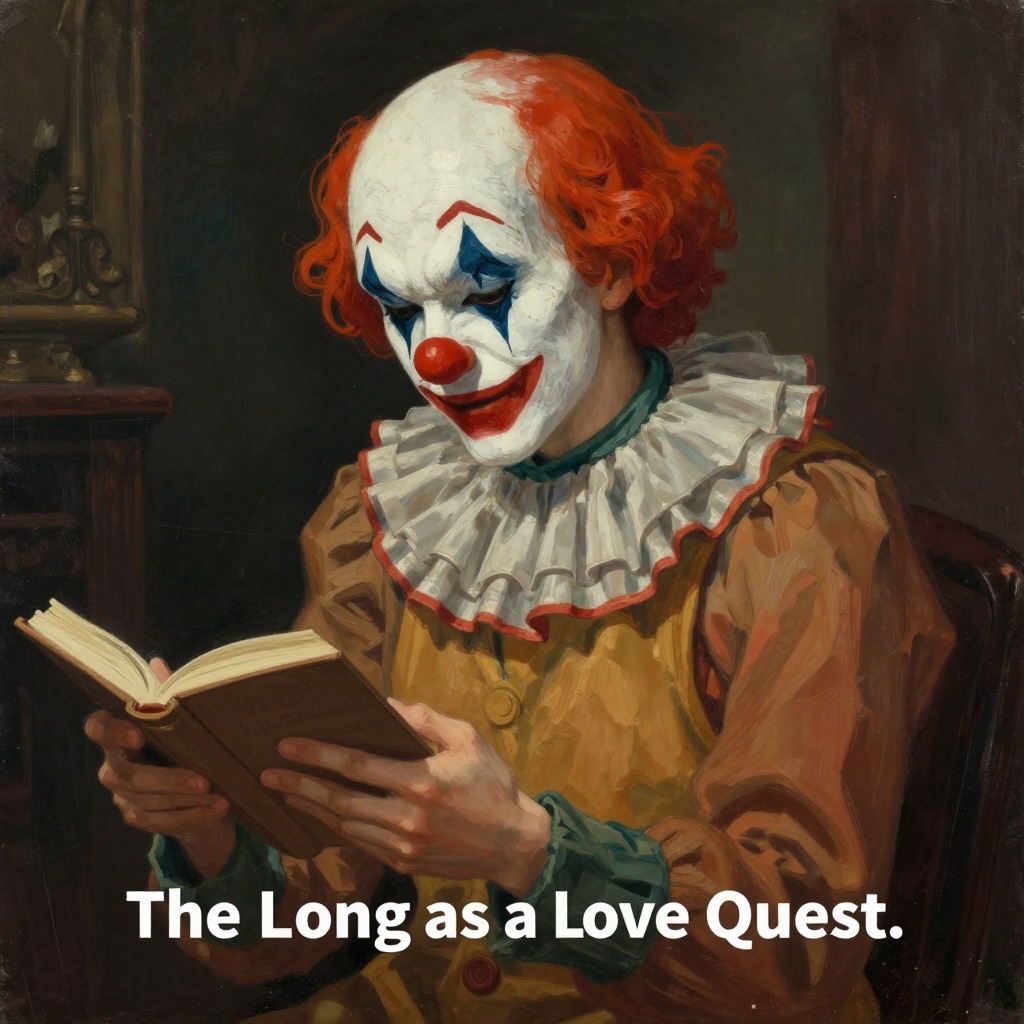
The Last Quest for Love is the name Yozo gives to the strategy of clowning that he invents as a child and maintains throughout his life. It is not a single event but a continuous mode of being, a desperate performance designed to win the affection and tolerance of human beings he secretly fears and cannot understand. This quest is the central psychological mechanism of his existence, the only bridge he can build between his terrified inner self and a society he experiences as alien and threatening. It is, as he states, "the last quest for love I was to direct at human beings."
Origins and Nature of the Clowning
Yozo's clowning arises directly from his profound inability to comprehend or participate in ordinary human life. From childhood, he is haunted by a sense of being fundamentally different: "Mine has been a life of much shame," he writes, and he confesses he "can't even guess myself what it must be to live the life of a human being." His apprehension on discovering that his concept of happiness seemed completely at variance with everyone else's was so great that it drove him to the brink of lunacy. Unable to feel the least particle of confidence in his ability to speak and act like a human being, he kept his solitary agonies locked in his breast. The clowning was born from this terror: "This was how I happened to invent my clowning." It was a role born of desperation, a way to maintain a smile on the surface while enduring excruciating efforts within. He thought, "As long as I can make them laugh, it doesn't matter how, I'll be all right. If I succeed in that, the human beings probably won't mind it too much if I remain outside their lives."
The Clowning in Action: Childhood and School
As a child, Yozo perfected his role as the farcical eccentric. He never answered back to his family, accepting criticism in silence while inwardly terrified. His antics were extended even to the servants, whom he feared even more than his family. In the summer, he made everybody laugh by sauntering through the house wearing a red woolen sweater under his cotton kimono, though he had actually pulled his little sister's leggings over his arms to create the illusion. At school, he acquired a reputation for being a "mischievous little imp" and a talented comedian. He wrote funny stories for composition class, knowing the teacher secretly enjoyed them, and made the other children laugh with his drawings. His report card was all A's except for deportment, where it was never better than a C or a D. Yet his true nature was diametrically opposed to this role; the clowning was a mask to hide his real self, which he felt was already disqualified from living among human beings.
The Clowning as a Shield Against Exposure
The clowning was not merely a performance but a desperate defense against the terrifying possibility of being seen through. The most devastating moment of his early life came when the simpleton classmate Takeichi poked him in the back and murmured, "You did it on purpose," after Yozo had deliberately missed the horizontal bar to make everyone laugh. This single revelation felt like seeing the world burst into the raging flames of hell. It was one of the two great disasters in a lifetime of acting. The other came years later, when a district attorney, after Yozo feigned a cough of blood, asked with a quiet smile, "Was that real?" This gentle contempt was worse than any punishment. The clowning was thus a fragile shield, and any crack in it threatened to expose the harrowing reality he had so desperately hidden.
The Clowning and Relationships with Women
Yozo's clowning also shaped his relationships with women, who found him both amusing and vulnerable. He notes that women were less demanding than men when it came to his antics, and they would ask for more, exhausting him with their insatiable demands for encores. He felt that many women were able to instinctively sniff out his loneliness, and this became one of the causes of his being taken advantage of. The clowning was a form of passive service, a way to ingratiate himself with women he feared, even as he felt a bitterness akin to shame when Horiki pointed out that an atmosphere of the "lady-killer" clung to him. This atmosphere was an unexpected by-product of his apprenticeship with prostitutes, whom he sought to escape his dread of human beings, but it only deepened his sense of being a fraud.
The Collapse of the Clowning and Its Aftermath
As Yozo's life descends into alcoholism, morphine addiction, and institutionalization, the clowning becomes increasingly hollow and unsustainable. After his wife Yoshiko is violated, he loses all confidence in himself and doubts all men immeasurably. His only resort is drink, and his face coarsens. The clowning, once a desperate bid for love, now serves only to mask his shame and despair. In the end, after being committed to a mental hospital, he reflects that he has now ceased utterly to be a human being. The quest for love through clowning has failed completely, leaving him a "reject" with neither happiness nor unhappiness. The epilogue reveals that the madam of the Kyobashi bar, who knew him, described him as "so easy-going and amusing" and, despite everything, "a good boy, an angel." This final judgment, from the only objective witness, suggests that the clowning, however desperate and self-destructive, was also a manifestation of a gentleness and capacity for love that Yozo himself could not see.